Rocket Lab: Electron
Rocket Profiles: Electron
1. Introduction
When Rocket Lab’s Electron lifted off from the company’s private launch site on the Māhia Peninsula in New Zealand on May 25, 2017, it introduced a fundamentally different approach to orbital propulsion. Where every prior orbital rocket had relied on some variation of gas-generator, staged-combustion, or pressure-fed cycles to deliver propellant to the combustion chamber, Electron’s Rutherford engines used electric motors and lithium polymer batteries to drive their propellant pumps — a first for any orbital-class launch vehicle.
Electron was conceived specifically to serve the small satellite market: a class of spacecraft, often in the tens to low hundreds of kilograms, that had historically been forced to fly as secondary payloads on much larger rockets, waiting on someone else’s launch schedule and not necessarily going to the optimal orbit. Electron offered these operators a dedicated ride, on a manifest and to an orbit of their own choosing.
This article, the first in our Rocket Profiles series, examines the Electron launch vehicle including its physical configuration, its propulsion architecture, payload capabilities, and the orbital regimes it’s capable of reaching. A follow on article will cover Rocket Lab as a company, Electron’s manufacturing approach, and details on launch infrastructure.
2. General Specifications
Electron is a two-stage orbital launch vehicle, with the option of a third-stage kick stage for missions requiring precise orbit insertion or multiple burns. It stands approximately 18 meters tall with a diameter of 1.2 meters, giving it a slender profile relative to its height. Fully fueled at liftoff, Electron has a total mass of roughly 13 metric tons, putting it firmly in the small-launch-vehicle category alongside rockets like Firefly Alpha and the SSLV, rather than in the same class as medium- or heavy-lift vehicles.
The payload fairing, which protects the spacecraft during ascent and is jettisoned once the vehicle clears the dense lower atmosphere, measures around 2.5 meters in length with the same 1.2-meter diameter as the rest of the vehicle, and weighs approximately 44 kilograms. The fairing is a split clam shell design and provides environmental control for the payload. The fairing also provides foam sheet acoustic protection and a pneumatic powered hinge rotation system for safe separation.
Electron was originally designed as a fully expendable vehicle, but Rocket Lab has since pursued partial reusability of the first stage. Rather than the propulsive landing approach used by some larger rockets, Electron’s first stage is designed to survive reentry and descend under parachute for recovery from the ocean, with Rocket Lab having also tested mid-air capture of the descending stage by helicopter. They were succeful in proving the concept in 2022, but have since refocused on recovery from sea. This reusability effort is a comparatively recent addition to the vehicle’s technical profile, layered onto a design that was not originally built around it — a point worth keeping in mind when comparing Electron’s recovery approach to vehicles designed for reuse from the outset.
Since its maiden flight in 2017, Electron has flown 91 missions with a success rate of 95% at the time of writing. Refer to Rocket Lab’s current mission manifest for updates.
3. Propulsion System
Electron’s propulsion system is built around the Rutherford engine, and it’s here that the vehicle departs most sharply from conventional rocket design. Nearly every liquid-fueled orbital rocket before Electron used propellant pumps driven by some form of combustion-powered turbopump — either a gas generator that burns a small fraction of propellant to spin the pump, or a more complex staged-combustion cycle. Rutherford instead uses brushless DC electric motors, powered by lithium polymer batteries, to drive the pumps that feed propellant into the combustion chamber. The result is a mechanically simpler engine: no turbine, no complex plumbing to route hot gas back into the combustion cycle, and more straightforward throttle control, since pump speed is governed electronically rather than by combustion dynamics.
The tradeoff is that batteries add mass and must be sized carefully against the thrust and burn duration required, which is part of why Rutherford is best suited to a smaller vehicle rather than a heavy-lift rocket. Rocket Lab has partially addressed this over time by improving battery energy density, which has been a direct contributor to the payload capacity increases Electron has seen since its debut.
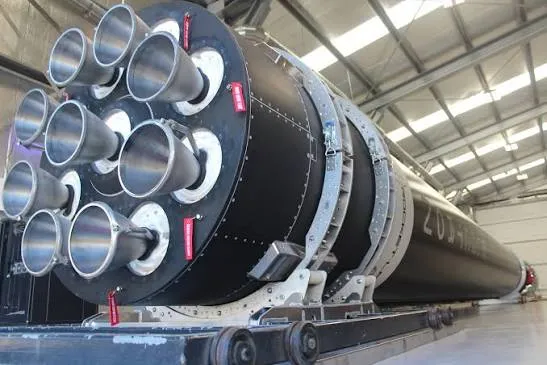
Electron’s first stage is powered by nine Rutherford engines arranged in a cluster, running on RP-1 (a refined kerosene) and liquid oxygen. This sea-level-optimized version produces a combined thrust in the range of 224 kilonewtons at liftoff, with a specific impulse of around 311 seconds. The second stage carries a single Rutherford engine, modified with a larger expansion nozzle optimized for the vacuum of space rather than sea-level atmospheric pressure. This vacuum variant delivers a higher specific impulse, in the region of 343 seconds, reflecting the efficiency gains possible when an engine doesn’t have to contend with back-pressure from the atmosphere.
A further distinguishing feature of Rutherford is its manufacturing method: the primary components of the engine, including the combustion chamber, injector, and pump housings, are 3D printed. This is as much a propulsion design choice as a production one, since additive manufacturing allows for internal geometries — particularly for cooling channels and propellant flow paths — that would be difficult or impossible to machine conventionally.
For missions requiring precise orbital insertion, circularization, or multiple discrete burns to reach a specific target orbit, Electron carries an optional third stage: the kick stage, powered by Rocket Lab’s Curie engine. Curie runs on a storable, Rocket Lab-developed “green” bipropellant rather than the cryogenic and refined-kerosene propellants used on the first two stages, and is capable of restarting multiple times during a single mission. This gives the kick stage the flexibility to deploy multiple payloads to different orbits on a single launch, or to execute the burns necessary to place a single payload into a precise, circular target orbit rather than the more elliptical orbit a two-stage-only ascent would leave it in.
Photon, a satellite bus Rocket Lab derived from the kick stage architecture, extends this same propulsion lineage further: it’s built to provide on-orbit maneuvering for lunar and interplanetary trajectories, effectively taking the kick stage’s multi-burn capability and applying it to deep-space missions rather than Earth-orbit insertion.
4. Payload Capabilities
Electron’s payload capacity has grown over the course of its operational life, primarily as a result of the battery improvements described above rather than any change to the vehicle’s basic architecture. At debut, Electron was rated to carry up to 225 kilograms to low Earth orbit, or 150 kilograms to a 500-kilometer Sun-synchronous orbit. Since then, Rocket Lab has increased these figures, with the vehicle now rated to deliver up to roughly 320 kilograms to LEO and around 200 kilograms to SSO at 500 kilometers.
These numbers place Electron firmly in the dedicated small-launch category — well below the payload capacity of medium- and heavy-lift vehicles, but purpose-built for a payload class that those larger vehicles serve poorly. A satellite in the 50–300 kilogram range flying as a secondary payload on a large rocket has little control over its launch date or its final orbit; it goes where the primary payload is going, on the primary payload’s schedule. Electron’s business proposition rests on giving that same class of satellite a dedicated launch and a chosen orbit.
The kick stage plays a direct role in payload delivery as well. Beyond simply adding a third burn stage, it allows Electron to carry up to around 150 kilograms of payload through to a final, precisely circularized orbit, and its multiple-restart capability means a single Electron launch can deploy several satellites to distinct orbital planes or altitudes in one mission, rather than dropping all payloads at a single point in space.
Fairing volume, at roughly 2.5 meters in length and 1.2 meters in diameter, sets the physical envelope customers must design their spacecraft around. It’s a modest volume by comparison with larger vehicles, again consistent with Electron’s target payload class of cubesats and small satellites rather than larger spacecraft or constellations requiring bulk volume.
5. Orbits Serviced
Electron flies from two launch sites. Its primary pad, Launch Complex 1, sits on the Māhia Peninsula on New Zealand’s North Island — the world’s first private orbital launch site, chosen in part for the wide range of orbital inclinations it can reach without overflying populated landmasses. A second pad, Launch Complex 2, is located at NASA’s Wallops Flight Facility in Virginia, giving Rocket Lab an additional site for missions requiring specific inclinations or U.S. government launch requirements.Māhia’s location gives Electron a wide range of achievable inclinations, including the near-polar inclinations SSO requires, without the need to launch over populated areas.
Electron’s most common destination is Sun-synchronous orbit, a nearly polar orbit in which a satellite crosses any given latitude at the same local solar time on every pass. SSO is heavily favored by Earth-imaging, remote-sensing, and Earth-observation satellites, since consistent lighting conditions on each pass make comparative imaging over time far more useful. Beyond SSO, Electron is capable of reaching a range of other low Earth orbits at varying inclinations and altitudes, depending on mission requirements, and its Wallops Island pad provides an alternate launch azimuth option for missions with different inclination needs than Māhia can efficiently support.
Electron’s capabilities extend beyond LEO as well. In June 2022, an Electron topped with a Photon upper stage launched NASA’s CAPSTONE mission, a roughly 25-kilogram CubeSat, on a trajectory toward a near-rectilinear halo orbit around the Moon. It’s a notable technical demonstration: a small dedicated launch vehicle, paired with its own kick-stage-derived upper stage, delivering a payload not just to Earth orbit but onto an outbound lunar trajectory — a capability normally associated with much larger vehicles. Photon has since been developed further for interplanetary trajectories, including Mars-bound mission concepts, extending Electron’s demonstrated reach from Earth orbit out toward deep space.
Across all of these destinations, the kick stage or Photon upper stage is what does the precision work — taking the two-stage vehicle’s initial elliptical trajectory and refining it, through one or more additional burns, into whatever specific orbit or trajectory the mission actually requires.
6. Closing Summary
Electron’s technical identity is defined by a specific combination of choices: an electric-pump-fed engine cycle that trades raw performance for mechanical simplicity and control, 3D-printed engine hardware, a multi-restart kick stage for orbital precision, and a payload capacity purpose-built for the small satellite class rather than scaled down from a larger design. Together, these choices have let Electron carve out a dedicated small-sat missions to Sun-synchronous and other low Earth orbits niche, with demonstrated that few other vehicles, large or small, are built to match.
Electron manufacturing and how the vehicle fits into Rocket Lab’s broader business will be the topic of a future article.